Showing posts with label reviews. Show all posts

Tuesday, April 22, 2008

All Over the Internets

I've been busy and too tired from being busy to post all the places I've been and still am on the Internets so here's the round-up:

Conversations Book Club interview at the Richard Wright public library:

Adblock


AuthorViews interview at the NOLA Bookfair:


Carp(e) Libris review and book giveaway

Carp(e) Libris interview

Thanks, Diane, for reviewing my book, hosting the giveaway, and posting the interview. It was great fun. Next book, I'll do it all again.

And an oldie but goodie: Crystal K.'s interview on WTUL, part of the Katrina Warriors Network reading project: The Podcast

Thanks, Crystal. It was a lot of fun and when my life is less like a race to the grave, we should do it a 3rd time. With questions from listeners this time, yeah, like my friend Preston Allen is doing at his All or Nothing blog.

Monday, March 10, 2008

Review: Press-Register, March 2

It's an honor to be read like this.

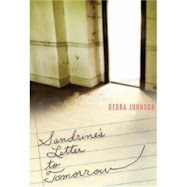
A child at the crossroads Innocence, awareness intertwine in Dedra Johnson debut

Sandrine's first escape route comes through the books she reads voraciously, among them "Little House on the Prairie," "A Wrinkle in Time" and "Watership Down." She also reads biographies of Frederick Douglass, Mary McLeod Bethune and Harriet Tubman. She defines herself through the words of writers and the lives of historical icons, and she uses these lessons to find her own voice. In keeping with Tubman's example, Sandrine and her classmate Lydia, also an abuse victim, become an Underground Railroad for one another:

Lydia showed me how to hold keys in my hand with the points sticking out, a sharp fist to scratch, poke or punch with. I told her the back ways we took to school and she said I was smart, that she hadn't thought of it.

Johnson lets objects and moments tell their own stories when she shows the reader a blurred Polaroid of a mystery woman on the mantle and a jar of Mamalita's pomegranate jelly. She also writes of Catholic schoolchildren who wear their house keys like rosaries. Johnson skillfully lets these scenes breathe and keeps the reader within the present-tense moment. The effect pays off. There is no adult Sandrine looking back, putting her childhood in perspective. Johnson shows her protagonist in real time, the questions in her life still intact and unanswered.

In one scene, Sandrine and her classmates make papier-maché American flags to celebrate the Bicentennial. Perhaps this image captures the essence of "Sandrine's Letter to Tomorrow," the story of a young girl crafting her independence. To that end, Sandrine draws upon lessons learned from the kindnesses and cruelties she has encountered in her young life. In a powerful debut effort, Johnson shows us how these acts affect the lives of children.

Ravi Howard, Mobile Press-Register, March 2, 2008

Friday, November 30, 2007

Ta-Dah!

I didn't know People did book reviews. Why is my book labeled "Novel" while Grafton's book is labeled "Fiction." Dare I ask?

page 59:


(3 out of 4 stars) Innocence, it seems, can be hard to crush: Nine-year-old Sandrine Miller--the straight-A student in 1970s New Orleans who narrates Johnson's heartbreaking debut--is beaten by her mother, abandoned by her loving but restless father and sexually abused by two family friends. Yet she's too young to realize the horror of it all; astonishingly, she remains unshakeably [sic] loyal to the grown-ups who let her down. Until the day she cracks: "I heard what sounded like a thick old voice but slowly recognized it as mine, full of tears, hoarse, broken by hiccup sobs." The only thing this affecting story lacks is a bigger picture, wondering how the wounded Sandrine will fare as an adult, readers may be left wishing Tomorrow could write back.

Monday, November 5, 2007

Review: Times-Picayune, Nov. 4

Only a Day Away by Susan Larsen:

Johnson perfectly captures the voice of a young girl, searching for acceptance and friendship. In Sister Paul and the nuns at her New Orleans school, Sandrine finds mentors and models for kindness; in the women who work at her father's clinic, she finds solace. In a new life with her father, she allows herself to feel "small and safe," confident that she has come home at last. After such a bleak existence, she is allowed that ray of hope, that most basic right of childhood.

Tuesday, October 16, 2007

Review: Booklist Oct. 15

Sandrine's Letter to Tomorrow
Johnson, Dedra (Author)
Nov. 2007. 212 p. Ig, paperback, $14.95. (9780978843120).

Growing up in New Orleans in the 1970s, Sandrine is proud to be black, but because she is light-skinned and very smart, the black kids think she is stuck-up, and the white kids won’t speak to her because, to them, she is black. At home, her single-parent mother beats her, makes her scrub the house constantly, and blames her for being a slut when she is sexually abused. For a brief time, Sandrine has one white friend at school, but Lydia also has dark secrets, and she shows Sandrine that the vicious prejudice they encounter is not only about race and class, but also about gender, and that many believe educating a girl is a waste. This debut novel is more a short story with one repeated theme played out in family, Catholic school, and neighborhood. But the obsession never gets boring or messagey, the dialogue is fast and lively, and Sandrine’s first-person narrative delivers immediate, searing drama, showing her pride, passion, and courage as she breaks stereotypes.

— Hazel Rochman

Tuesday, September 25, 2007

Review: Publishers Weekly

Sandrine's Letter to Tomorrow
Dedra Johnson. Ig (Consortium, dist.), $14.95 paper (212p) ISBN 978-0-9788431-2-0

This aching debut explores a girl's coming-of-age in poverty-drenched mid-1970s New Orleans. Eight-year-old Sandrine Miller lives like a servant to her mother, Shirleen, a low-wage typist, and her mean-spirited grandmother, Mother Dear, both of whom keep Sandrine overloaded with chores despite her homework and eagerness to keep up good grades at school. Sandrine's main escape is visiting her father and his mother, Mamalita, in the country for the summer, but her dream of moving there is crushed when Mamalita dies, and her busy country doctor dad leaves Sandrine in the noncare of his girlfriend, Philipa, whose dotty daughter, Yolanda, is, to Sandrine's bookish disgust, more interested in boys than her education. Indeed, Sandrine feels wronged, especially by her mother, who holds Sandrine's light skin against her. As she grows, Sandrine finds empowerment in knowledge of her body (taught to her by an older classmate, Lydia, whose step-dad molests her) and the recognition that learning is her only escape from the defeating cycle of early pregnancy, poverty and general futility. There are echoes of I Know Why the Caged Bird Sings, and Sandrine, with her fierce price [sic], is an instantly likable underdog. (Nov.)